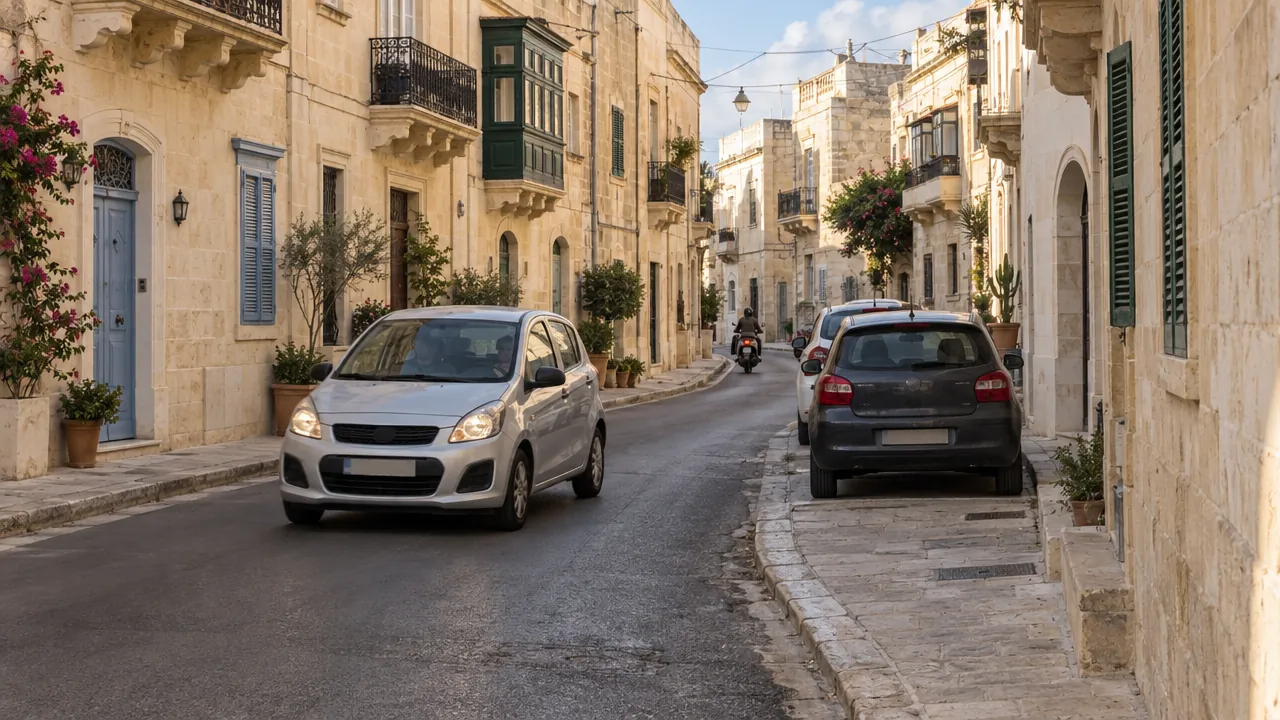
Driving a hire car in Malta
Malta drives on the left, making it an unusually familiar European destination for UK motorists. Hire cars are generally right-hand drive, too. Even so, familiar vehicle controls do not mean that the roads, junctions or other drivers will feel like those at home.
Roads can be narrow and busy, parking is difficult in popular areas, and local driving habits may take time to get used to. Malta is compact, but a short distance on a map does not necessarily mean a quick journey.
For most UK holidaymakers who want a car, flying to Malta and hiring one locally is more practical than shipping their own vehicle, although shipping is technically possible. A hire car can be useful for travelling beyond Valletta and the main tourist areas, or for visiting Gozo.
Documents and rental eligibility
You need a full, valid driving licence to drive in Malta. Visitors can use a UK photocard licence without an International Driving Permit, although a rental company may set its own requirements. Check its terms before travelling rather than relying only on the general rule.
If you have an older paper UK licence, check the latest UK government guidance before your trip. You may need to change it for a photocard licence or obtain an International Driving Permit; do not assume the arrangements for a photocard apply to your document.
Carry your passport or another accepted form of identification, and keep the rental agreement with you while driving the hire car. Having the agreement accessible also makes it easier to check the company’s conditions if a question arises during the trip.
Malta’s legal minimum driving age is 18, but that does not oblige a rental company to hire to every driver aged 18 or over. Companies can require a higher minimum age or more driving experience, and younger drivers may face extra charges.
Choosing and collecting a hire car
Read the insurance terms before booking, particularly the excess: a low advertised rental price may leave you responsible for a substantial amount if the car is damaged or stolen. Basic cover may exclude tyres, wheels, windscreens, underbody damage or lost keys, so check what is actually included.
Before leaving the rental site, photograph or video the vehicle carefully. Include the wheels, tyres, bumpers, glass and interior, as well as any obvious bodywork marks. Make sure every mark already on the car is recorded on the rental paperwork or in the company’s app.
Check the fuel policy, any mileage allowance and the emergency contact details while you still have an opportunity to ask questions. Understand what the company expects you to do if the car is damaged; arranging your own repair or recovery may not follow its procedure.
If you intend to take the car to Gozo, confirm in advance that the agreement permits it. Ask specifically whether the insurance remains valid during the ferry crossing and while the vehicle is on Gozo. Permission to use a hire car in Malta should not be taken as permission for the ferry.
Consider the size of car you actually need. A smaller vehicle will usually be easier to manoeuvre through villages, narrow streets and car parks. Malta’s short distances give little practical advantage to hiring a larger car simply for the sake of having more vehicle.
Driving on the left and navigating junctions
As in the UK, traffic keeps left and overtaking is on the right. Most hire cars have the steering wheel on the right. Those similarities remove some of the adjustment that UK drivers face elsewhere in Europe, but they are no reason to stop paying attention.
Road layouts, markings, junction priorities and local habits may still be unfamiliar. At unsigned junctions, traffic coming from the right may have priority. Approach roundabouts carefully, slow down and follow the markings rather than assuming that another driver will signal clearly or behave as you expect.
Scooters and motorcycles are common, while built-up areas can feel particularly busy. Before changing lane or turning, check mirrors and blind spots carefully. Give yourself room to respond to what nearby vehicles are doing, not just to what you think they ought to do.
Speed limits and enforcement
Speed limits in Malta are shown in kilometres per hour, not miles per hour. There are no motorways. Check your hire car’s speed display and pay attention to signs, especially if you are accustomed to judging speeds using UK road limits.
Unless a sign states otherwise, the usual limit for a car in a built-up area is 50 km/h (31 mph). On roads outside built-up areas, it is up to 80 km/h (49 mph). These figures are general limits, not a promise that a particular road permits either speed.
Many roads have lower posted limits. Follow the signs rather than assuming that 50 km/h or 80 km/h applies throughout a journey. In practice, junctions, roundabouts and congestion often affect arrival times more than the highest speed permitted on a clear stretch.
Speed cameras are used in Malta. Do not rely on old advice about camera-warning or detection equipment: check the current rules before using a detector or a satnav feature specifically designed to identify enforcement locations.
Alcohol, seatbelts and child restraints
Malta’s standard drink-drive limit is 0.5 g/l. That is lower than the 0.8 g/l limit in England, Wales and Northern Ireland, and the same as the limit in Scotland. The straightforward approach if you are driving is not to drink.
A long lunch or evening on holiday can make it easy to underestimate how much alcohol you have consumed before getting back into an unfamiliar car. Police can carry out alcohol testing, and Malta has strengthened its laws and penalties concerning driving under the influence.
Everyone in the car must wear a seatbelt where one is fitted. Children under three must use an appropriate child restraint. Older children also need a restraint suited to their size, with further rules determining when an adult seatbelt may be used.
If you are travelling with children, arrange suitable seats with the rental company before arrival or bring your own. Do not assume the right type will be available if you request it only at the desk. A rear-facing child seat used in the front passenger seat requires the passenger airbag to be switched off.
Road conditions and everyday driving
Malta has no motorways and its distances are relatively short, yet driving can still be tiring. Roads around Valletta and the main urban areas can be heavily congested. Village and rural routes may be narrow, uneven or lined with parked vehicles, leaving little room to pass.
Allow more time than the mileage suggests, particularly during busy periods: a trip of only a few miles can take considerably longer than expected. Main roads have improved substantially over time, but smaller routes may still have potholes, raised surfaces, tight corners or sudden changes in width.
Do not count on every driver indicating before a turn or lane change. Leave space around the car and watch how traffic actually moves. This matters especially where narrow streets, parked cars and motorcycles bring different road users close together.
Mobile phone use while driving is restricted. Set up navigation and calls before moving off, and use a proper hands-free system where permitted. Use dipped headlights in tunnels and whenever visibility makes them necessary.
Driving into Valletta
You generally do not need a car to see Valletta itself. The city is compact, parking is limited, and much of its historic centre is better explored on foot. Driving there may add a parking problem rather than make a visit easier.
Valletta has a Controlled Vehicular Access system, known as CVA. Cameras record when vehicles enter and leave the controlled area. A charge may apply according to how long the vehicle stays inside, so check the arrangements before driving into the zone.
If the vehicle is hired, ask the rental company how it handles CVA charges. It may pass a charge on to you later, potentially adding an administration fee. Knowing this in advance helps avoid confusing a later rental-company charge with the original access charge.
For many visitors, parking outside the centre and continuing on foot or by public transport will be simpler than taking a car into Valletta. It is worth deciding where to leave the vehicle before setting off, rather than looking for space within the historic centre.
Taking a car to Gozo
Gozo is smaller and generally quieter than Malta. A car can be useful there for reaching beaches, villages and rural attractions, but the island’s quieter character does not mean every road is broad or easy to drive.
Vehicles can travel between Malta and Gozo by ferry. If yours is a hire car, check the agreement before making the crossing and confirm both permission to take it aboard and continued insurance cover on the ferry and on Gozo.
Gozo’s roads can be narrow, steep or rural. Do not assume that a route suggested by a navigation app is a wide, straightforward road. A compact car may be helpful here for the same reasons it can be useful in Malta’s villages and car parks.
Fuel is available on Gozo, but avoid letting the tank run very low when exploring away from the main towns. Short distances should make planning manageable; they are not a reason to ignore the fuel gauge.
Parking and road markings
Parking can be frustrating around Valletta, Sliema, St Julian’s and other busy places. Check markings and nearby signs before leaving the car rather than treating an empty bay as automatically available to visitors.
White bays are generally available for normal parking, while yellow markings indicate restrictions. Bays in other colours may be reserved for residents, limited to particular times or designated for specific users. The relevant sign is important even when a space appears unoccupied.
Do not park across entrances, at bus stops or pedestrian crossings, or anywhere you would obstruct traffic. Narrow streets leave little clearance when a vehicle is badly parked, so consider whether other drivers and road users can pass safely.
If you are staying in a busy area, accommodation with dedicated parking may justify its extra cost. Otherwise, a public car park or park-and-ride facility may be more practical than repeatedly circling narrow streets in search of a free space.
Equipment to check in the car
A hire car should contain the safety equipment required under Maltese rules. Check what is present before leaving the rental site, and ask the company to replace anything it should have supplied but has not. Do this while the vehicle is still at collection.
A warning triangle matters if the car breaks down or obstructs the road. Malta’s road code says to place it at least 50 metres behind a broken-down vehicle when it is safe to do so. Your own safety takes priority when deciding whether you can place it.
A high-visibility jacket is also sensible to have, along with a first-aid kit and basic emergency supplies. These are useful items to check alongside the equipment supplied with the vehicle; do not assume that every item you would like to carry is already inside.
A UK visitor hiring a Maltese car does not need headlamp beam deflectors on account of a change in driving side. Both countries drive on the left, and the hire car will generally be set up for Maltese roads.
Fuel, charging and summer journeys
Petrol and diesel are readily available across Malta, and short distances mean fuel planning is rarely difficult. Some filling stations are attended during the day but operate as self-service outside staffed hours, so carrying more than one payment option is sensible.
If you are considering an electric hire car, check where you will stay and where you expect to charge before choosing it. Malta’s compact size can suit electric driving, but convenient overnight charging may matter more to your plans than the mere presence of public chargers nearby.
In summer, keep water in the car. Air-conditioning can be an important feature rather than an optional comfort in the heat, so check that it works properly before driving away from the rental site.
Accidents and breakdowns
Malta has a specific reporting procedure for a minor bumper-to-bumper collision when nobody is injured, rather than automatically requiring police attendance. Make sure you understand the applicable process when you collect the hire car, before you might need to use it.
For a more serious incident, or whenever anyone is injured, contact the appropriate authorities. Also contact the rental company if you are driving its car, and follow its instructions before arranging repairs or recovery yourself. Keep its emergency number readily accessible rather than searching for it after an accident.
If the car breaks down, move it out of the traffic flow if you can, switch on the hazard lights and warn other road users. Do not stand in a dangerous position beside the vehicle. Place the warning triangle only where and when it is safe.
Getting emergency help
Dial 112 if you need emergency help in Malta. This European emergency number connects callers to police, ambulance or fire services and is free to call. Keep it distinct from the rental company’s number, which is for matters involving the hire vehicle.
English is an official language in Malta, so communicating with emergency services should generally be straightforward for UK visitors. Once everyone is safe, contact the rental company about its car and follow its directions; do not organise repairs or recovery yourself unless it tells you to.
Mistakes worth avoiding
The first mistake is assuming that driving will be almost identical to driving in the UK because both countries keep left. Malta’s junctions, road layouts, local habits, traffic and parking can all feel different, even when the steering wheel is on the familiar side.
Another is hiring more car than you need. Distances are short and many roads and parking spaces are tight. A smaller vehicle is often easier to manage, particularly if your plans involve villages or Gozo rather than only main roads.
Trying to drive everywhere can also make a trip harder. Valletta is often simpler to explore without a car, and its CVA system adds another consideration if you enter the controlled area. Plan where driving will genuinely help before committing to each journey.
Do not overlook the rental excess, exclusions or the condition report. Check the insurance, document existing damage and know what to do if new damage occurs. Equally, do not underestimate congestion: leave ample time, especially when heading to the airport or a ferry.
Checks before you set off
Keep your driving licence, passport or other accepted identification, and rental agreement accessible. Check the insurance terms and excess, along with the company’s emergency number, fuel or charging policy and any mileage allowance. If Gozo is on your itinerary, confirm ferry permission and cover.
Before departure, check for the warning triangle and other safety equipment the company should supply. Arrange suitable child seats if needed, and photograph or video any existing vehicle damage. Confirm that the air-conditioning works if you expect to rely on it.
A phone charging cable, offline maps or another navigation backup, and water are useful to have with you. Set up your route before moving off, then allow for traffic rather than judging the journey solely by distance.
Driving on the left gives UK visitors one less adjustment to make in Malta. The greater challenges are likely to be congestion, narrow roads and parking. A suitably sized hire car, clear rental terms and realistic journey times will help you decide when driving is useful—and when leaving the car parked is easier.