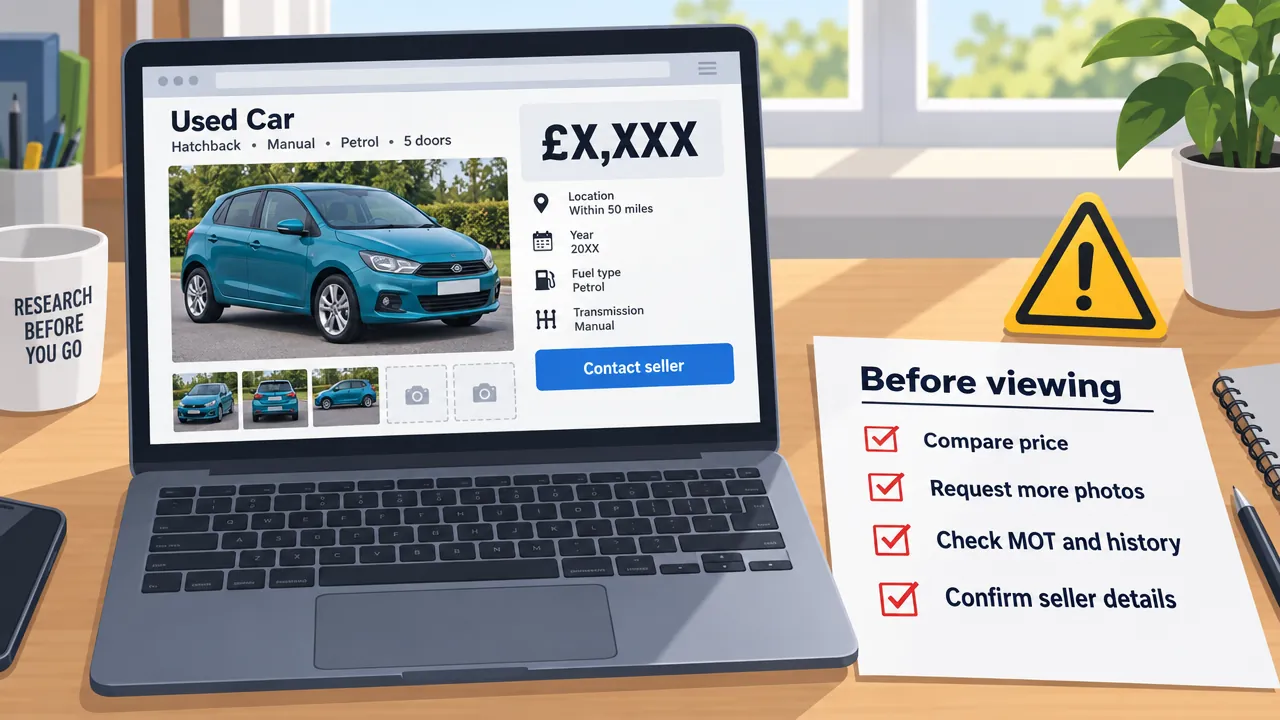
A polished hatchback at an attractive price can look convincing in an online advert. Marketplaces make used cars easier to find, but photographs and carefully chosen descriptions can also conceal problems before you arrange a viewing.
Checking tyres and service history matters, yet some of the most useful warnings appear earlier. Looking closely at the advert can spare you an unnecessary journey, an expensive repair or a more serious problem.
When the price looks unusually low
A price far below comparable cars is a reason to investigate, not proof of a bargain. UK used-car values are relatively easy to compare using valuation tools and other adverts, so a strikingly cheap car needs an explanation.
Compare examples of similar age, mileage and specification before deciding what the asking price means. A hidden fault, a history the seller would rather not discuss or even a nonexistent vehicle could account for a low figure. Sellers seldom overlook a large difference in value without a reason.
What the photographs show and hide
A useful set of pictures should show every side of the car, as well as the interior, dashboard and boot. Missing views are worth noting because they limit what you can judge before travelling to see it.
Borrowed images
Studio backdrops, dealer watermarks or surroundings inconsistent with the seller’s area warrant questions. Images can be copied from dealer sites or older listings, particularly in fraudulent adverts. A reverse image search can reveal whether those same photographs have appeared elsewhere.
Rain, shade and missing angles
Rain can give paintwork a glossy finish that makes swirl marks, small dents or mismatched panels harder to see. Dusk and deep shade can have a similar effect. If only a few flattering angles appear, request pictures of the omitted areas, such as a rear corner or the passenger side.
The point is not to diagnose the paintwork from a photograph. It is to recognise what the pictures cannot establish and ask to see those areas more clearly before making a journey.
Pressure and requests for money
Claims that another buyer is on the way or that the car will be gone tonight create pressure to decide quickly. Treat a request for a holding deposit before you have seen the vehicle with particular caution: do not transfer money for a car you have not viewed in person.
A claimed deadline gives you less time to compare the advert with other cars and check the vehicle’s details. Do not let a seller’s claims about competing buyers replace those checks.
Also be wary of a seller who says they are abroad and proposes delivery through a courier or an escrow service. That combination is a known fraud pattern, not a substitute for seeing the car yourself.
Descriptions worth questioning
Descriptions can minimise potentially costly faults. “Just needs a re-gas”, “minor warning light” and “easy fix” are not diagnoses. An air-conditioning system that has lost its gas may have a leak; a warning light could reflect anything from a loose sensor to a failing gearbox.
Check what the advert leaves out as carefully as what it says. Missing details about previous owners, the MOT expiry date or service records might reflect carelessness, but could also be deliberate. Ask direct questions and pay attention to whether the answers are clear.
Paperwork and vehicle history
The registration number may be shown in the photographs or written in the listing. If a seller refuses to provide it, consider that a warning: it prevents you from making straightforward checks before arranging a visit.
MOT records and mileage
The UK government’s free MOT history service shows previous test results, advisories and mileage recorded at each test. Look for a sudden fall in recorded mileage or a lengthy gap without a test, and ask the seller to explain either.
A mileage discrepancy or a gap without a test is a prompt for a question, rather than a complete account of what happened. Compare the seller’s explanation with the records available to you.
Repeated advisories for corrosion, suspension wear or brakes can be especially informative. The pattern across successive tests may tell you more about the car’s condition and upkeep than a short description in the advert.
Finance, write-offs and cloning
A paid vehicle-history check can reveal outstanding finance, insurance write-off categories and whether a car has been reported stolen. Category S denotes structural damage, while Category N denotes non-structural damage. Neither automatically rules out the car, but both affect its value.
Cloning is rarer but more serious: criminals copy the identity of a legitimate vehicle and attach it to a stolen car of the same make and model. At a viewing, compare the vehicle identification number on the V5C logbook with the number on the car, usually visible at the base of the windscreen.
Check who is selling
A trader may present themselves as a private seller to avoid the obligations that come with trading. In the UK, buying from a dealer brings protections under the Consumer Rights Act 2015; a private seller mainly has to describe the car accurately.
Look out for several cars advertised by one seller, or photographs of different vehicles in the same driveway. Where possible, view the car at the address shown on its logbook. A supermarket car park might be suggested for an ordinary reason, but meeting there removes a simple way to check the seller’s identity.
Those clues do not, on their own, establish that someone is a trader. They are reasons to clarify who is selling and whether the address and documents correspond to the car you are being shown.